
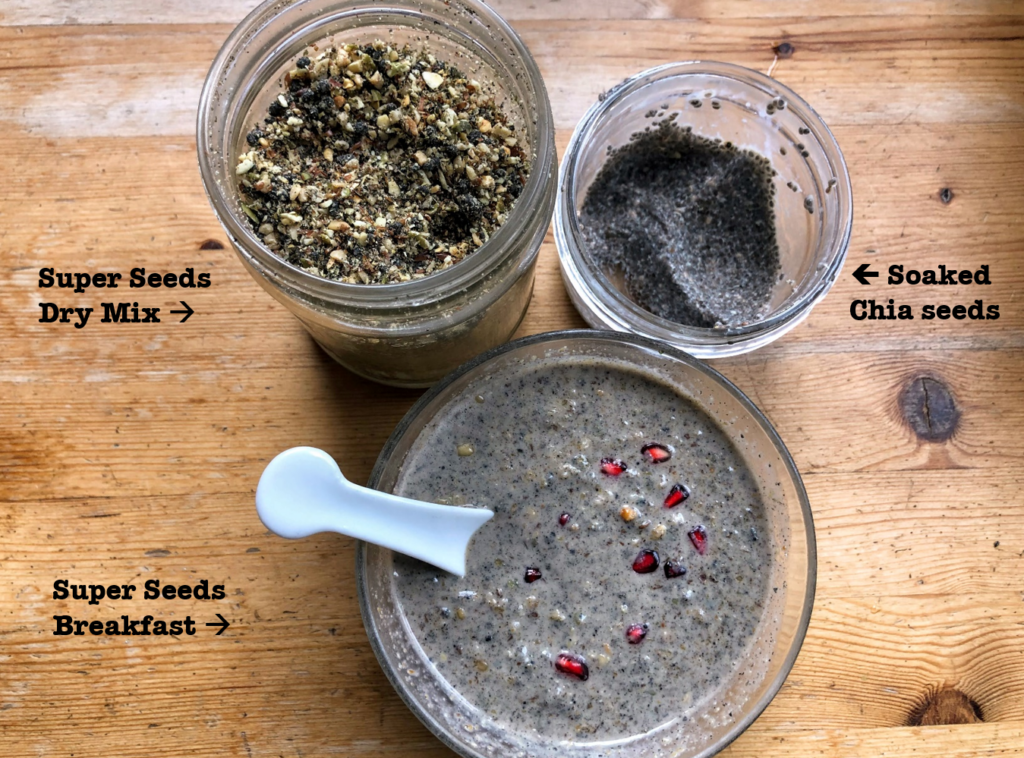
Last year I embarked on an experiment to get my sugars into a normal range and reduce sugar spikes and dips. I had been struggling with prediabetes for years, and now that I’m also dealing with midlife metabolic and inflammatory changes, I wanted to try to reverse it with changes in what I eat. After a lot of trial and error, I got my hemoglobin A1C down 0.5% and finally kept it in a normal range throughout the year. I focused on getting one meal “right” at a time and started with the one that fuels my entire day: breakfast. This super seeds mix delivers a ton of healthy fats, proteins and fiber. It is vegan and gluten-free. Importantly, it is delicious, endlessly riffable, and I look forward to eating it each morning. It gives me the energy I need for intense morning work sessions and keeps me satisfied for 4-5 hours.
TL;DR: Key Takeaways
Eating seeds daily is associated with reductions in common chronic illnesses. Here is the basic concept and recipe for my super seeds breakfast:
- Favorite seeds + nut/seed butter + milk
- Optional: psyllium husk, oatmeal
Jump to:
- Why seeds: back story and science
- Seed profiles: sesame, pumpkin, sunflower, chia, flax, hemp
- Super seeds mix recipe: visual step-by-step and detailed recipe card
Why seeds: how I came to love seeds and what the science says about them
Last year I shared with my good friend and colleague Dr. Laurence Freitas how much I was struggling to get my sugars (hemoglobin A1c, or HgA1c) down to a normal level and wanting a less-inflammatory diet. I have diabetes on both sides of my family, and I know I have to be proactive to prevent it. Dr. Laurence astutely pointed out that midlife metabolic changes (including perimenopause) were also likely having an impact, and it is a good time to shift to eating more nutrient-dense foods, such as seeds.
Seeds and nuts are indeed associated with numerous nutritional benefits, reduced cardiovascular disease, cancer, and all-cause mortality (death from any reason). Some seeds, such as chia and flax, have been associated with reduced inflammatory markers. Smaller studies have found that eating flax and chia seeds helps keep the blood glucose response more even, possibly with the higher fiber viscosity turning the glucose into a slower-release carbohydrate.
In my CGM testing, I found that increasing my seed intake and reducing my starch intake kept my sugars more even:
- When I ate plain oatmeal (starchy carb) with nothing else, my sugars spiked high and dipped low.
- When I ate fruit first, then oatmeal and egg (carbs first), my sugars spiked high and dipped low.
- When I replaced half of the oats with the super seeds mix, my sugars remained in the normal range and did not spike high or dip low.
Nuts and seeds have been eaten worldwide for millenia. They are rich in protein, fiber, healthy monounsaturated fatty acids (MUFAs), and polyunsaturated fatty acids (PUFAs). A 2022 meta-analysis found that the intake of 28 grams per day of nuts and/or seeds compared to not eating nuts or seeds was associated with a:
- 21% risk reduction in cardiovascular disease,
- 11% risk reduction in cancer deaths, and
- 22% reduction in all-cause mortality.
The evidence around seeds and nuts preventing the development of diabetes is mixed and inconclusive, so I can’t say that they prevent diabetes. They are high in calories due to their high fat content, so I’d recommend using the seeds to replace the calories of lesser-nutritional-quality foods (e.g. cereal, plain oatmeal, bread, juice). Given that eating seeds and nuts is associated with reducing diabetes-adjacent cardiovascular and cancer risks, I think they are a great choice for a healthier and sustainable food shift.
Not everyone can enjoy all seeds and nuts. About 0.1% of the world’s population has sesame seed allergies, which is the most common seed allergy, and about 1-3% of people living in Western countries have peanut and/or other nut allergies. If you or someone in your household has a seed/nut allergy, please adjust your seed and nut choices to the ones you can safely enjoy.
If you are a parent of a very young child, the current evidence suggests that introducing allergenic foods early (ideally before the age of 1) and regularly eating them (at least once per week) can help prevent the development of food allergies.
Given the health benefits and deliciousness of seeds and nuts, and that a vast majority of people can find some seeds that they can safely eat and enjoy, I want to offer a deeper dive into specific seeds.
Seed profiles
The following are the seeds that I feature in my super seeds mix because they taste good (to me :), are easily found in grocery stores and online, and are nutrient rich. Try to get unsalted and unseasoned seeds.
Sesame seeds

Sesame seeds are my tippy-top favorite seeds for their nutty, toasty flavor. I grew up eating sesame seeds and sesame oil on nearly everything. Whenever anyone in my family goes to our home village in Taiwan, I ask them to get me freshly ground roasted black sesame from a friend who sells it at her stand next to a mountainside Buddhist/Confucian temple.
Sesame is the oldest known oilseed crop and has been cultivated since ancient times, for over 5,000 years, likely originating in Africa. Sesame has been called a “survivor crop” which doesn’t require much tending and tolerates both drought and hot-wet conditions. It is widely grown in Asia and Africa, even at the edge of deserts.
In Traditional Chinese Medicine, black sesame seeds are used to treat hemorrhoids, gastroenteritis, constipation, amenorrhea, dysmenorrhea, ulcers, and hair loss. A recent meta-analysis found that sesame consumption is associated with lower fasting blood glucose and HbA1c.
- Which sesame seeds are healthiest? Raw and roasted sesame seeds each have pros and cons, so it’s unclear which is healthier (see next bullet point). Black sesame seeds have more anthocyanin antioxidants and have a stronger taste. My take on this data is to eat the sesame seeds you enjoy the most. 🙂 My faves are lightly roasted black sesame seeds for taste and digestibility.
- Raw vs. roasted: Some antioxidants, such as Vitamin E and total phenolic compounds, are increased with roasting sesame seeds while others, such as lignans, tannins and some minerals, are decreased. Sesame seeds, like most seeds, contain phytic acid, which prevents the absorption of minerals in the small intestine. Roasting decreases the phytic acid and therefore can increase the absorption of the minerals. A lightly roasted seed might help balance the conservation of nutrients while increasing digestibility and taste.
- Sesame seeds contain B vitamins, calcium, iron, and magnesium.
- Dried sesame seeds consist of 50% fat, 18% protein, 23% carbohydrates, and 12% fiber.
Sesame seed allergies are the most common seed allergy worldwide (~0.1% of the North American population) and can cause anaphylaxis (a severe allergic reaction), so please be mindful of potential allergies.
Pumpkin seeds

I love pepitas (pumpkin seeds) with their rich, nutty flavor. They are delicious as snacks, sprinkled onto other food, in moles and salsas (sikil p’ak, wow!). Originating in Mesoamerica, there is evidence from the Guilá Naquitz cave in Oaxaca that cultivation started over 8,000 years ago, pre-dating maíz. Pumpkin seeds have been used as folk remedies for overactive bladder, benign prostatic hyperplasia (BPH), parasites and kidney stones.
- Lightly roasted, unsalted pumpkin seeds likely provide the most health benefits.
- Raw vs. roasted: Roasted pumpkin seeds are easier to digest due to lower phytic acid levels. Light roasting also increases the bioavailability of minerals and antioxidants, such as polyphenols and Vitamin E. While raw pumpkin seeds have slightly more heat-sensitive vitamins (such as B vitamins), I much prefer the taste and digestibility of roasted pumpkin seeds. If you prefer raw ones, consider soaking and/or sprouting them to reduce phytic acid and increase digestibility.
- Pumpkin seeds contain zinc, phosphorus, magnesium, potassium, and selenium, which are essential for healthy metabolism and immune functioning.
- Roasted pumpkin seeds consist of 49% fat, 30% protein, 15% carbohydrates, and 7% fiber.
Sunflower seeds

Sunflowers are also native to the Americas, but originate further north and were likely cultivated by indigenous communities over 5,000 years ago in what is now called Arizona and New Mexico. The seeds have been used by many indigenous tribes as snacks and to make flour, meal and oil. I grew up eating them as a snack. Parts of the plant have been used medicinally to treat snakebite and skin ailments.
- Raw or lightly roasted, unsalted sunflower seeds probably provide the most health benefits.
- Raw vs. roasted: Raw sunflower seeds preserve more of their omega-3 fatty acids and antioxidant properties, such as vitamin E, polyphenols and flavonoids. Roasting makes them easier to digest, so if you prefer them roasted, a light roasting could preserve some nutrients while making it easier for you to digest them.
- Sunflower seeds contain copper, zinc, phosphorus, magnesium, potassium, and iron, which are essential for healthy metabolism and immune functioning.
- Dried sunflower seeds consist of 51% fat, 21% protein, 20% carbohydrates, and 9% fiber.
Chia seeds

Chia seeds are from a flowering salvia plant in the mint family, native to central and southern Mexico. Chia seeds have been a staple food for Nahuatl (Aztec) people and cultivated for at least 5,000 years. They have been roasted and ground into flour and used in drinks. The Tarahumara (Rarámuri) indigenous people in the northwest Mexican mountains use chia seeds as an important energy source in their ultra-long-distance (100+ miles) running rituals.
As a child, I only knew of chia seeds from Chia Pet ads on television. Chia Pets are terracotta figures with holes which sprout chia seed into hair and fur-like figures. Amazingly, Chia Pets are still alive and kicking! “Ch-ch-ch-chia! Watch It Grow!” It is so interesting to learn more about them now from such a different food and health angle.
Chia seeds have an outer layer of soluble polysaccharide fiber (mucilage) which absorbs water up to 12 times the seed’s weight to form a gel-like coating around each seed, which helps with protection and germination in dry soils. In food, this fascinating property makes chia seeds thicken foods and float in drinks, giving them interesting looks and textures. Soaking chia seeds before eating increases digestibility and nutrient absorption, and decreases the risk of the seeds getting stuck in your GI tract. This fibrous gel may help lower LDL cholesterol, slow down digestion and prevent sugar spikes.
- Soak raw chia seeds using a 1:5 seed-to-liquid ratio before eating them to increase safe digestibility and nutrient absorption. I soak 35-40 grams of chia seed in a jar with a cup of soy milk. After a few hours, they form their tapioca-like gel and are ready to scoop out and eat.
- Chia seeds contain B vitamins, riboflavin, folate, calcium, iron, magnesium, manganese, phosphorus, and zinc.
- Dried raw chia seeds consist of 33% fat, 17% protein, 38% carbohydrates, most of which (34 of 38%) is fiber.
Flax seeds

Flax plants are native to the region that includes the eastern Mediterranean to India. Flax was first cultivated in the Fertile Crescent region of the Middle East more than 9,000 years ago. There is evidence that wild flax was spun and dyed for textile fiber 30,000 years ago from ancient textiles found in the Dzudzuana cave of what is now the Republic of Georgia. Talk about vintage threads! Nowadays flax is cultivated as a food and fiber crop (linen) and thrives with minimal pesticides and fertilizers. A recent review describes how regular flaxseed consumption (30g/day) stabilizes blood glucose levels and reduces obesity, total cholesterol, LDL, triglycerides, liver enzymes, blood pressure, and inflammatory biomarkers.
- Ground whole flaxseed optimizes nutrient bioavailability.
- Flax seeds contain B vitamins, thiamine, magnesium, and phosphorus.
- Flax seeds have exceptionally high levels of ALA omega-3 fatty acids, which make up 50-60% of the seed’s total fat content and are linked to anti-oxidant, anti-inflammatory effects and improved glycemic control.
- Flax seeds consist of 42% fat, 18% protein, 29% carbohydrates, most of which (27 of 29%) is fiber.
Hemp seeds
I do not currently eat hemp seeds, but Dr. Laurence has mentioned them to me a few times, so I’m intrigued and want to try them out. Hemp seeds have a unique fatty acid composition, with a balanced omega-6-to-omega-3 fatty acid ratio, and early data suggests that eating hemp seeds regularly might improve lipid profiles and reduce inflammation.
Super Seeds Mix Recipe

Super Seeds Recipe: detailed instructions

Super Seeds Mix
Difficulty: Easy30
servings30
minutes1
minute96
kcalThis vegan and gluten-free recipe makes enough seed mix to eat with breakfast for about one month. I make 3x this recipe to last us 3 months. Add this mix to whatever you like: smoothies, oatmeal, cereal, milk, sprinkle on salads, yogurt and/or ice cream :). Feel free to adjust the seeds, amounts and grind to taste!
Ingredients
- Super Seeds Mix Base (30 servings)
100 grams (1 cup) Pumpkin seeds, shelled, roasted, unsalted
100 grams (⅔ cup) Sunflower seeds, shelled, raw or roasted, unsalted
100 grams (⅔ cup) Flax seeds, whole, ground
100 grams (⅔ cup) Black sesame seeds, roasted or raw, unsalted
Optional: Add more of your favorite seed(s) to taste. I add 200 grams more black sesame seed 🙂
Optional: 20 grams psyllium husk for extra fiber (warning: makes things very gooey, so start with a small amount)
40 grams (¼ cup) Chia seeds soaked in a separate jar with a cup of water or milk
- Super Seeds Breakfast (one serving)
20-30 grams (2 tbs) dry super seeds mix
10 grams (½ tbs) soaked chia seed
20 grams (1 tbs) nut or seed butter
Milk to desired texture and taste
Optional carbs: 20 grams (1 tbs) pre-cooked steel-cut oats, fresh fruit toppings
Directions
- Super Seeds Mix Base
- If you have whole seeds and prefer to eat them ground up, as I do, you can achieve a coarse grind using a mortar and pestle or a finer grind by pulsing them for a few seconds in a food processor.
- Mix the seeds (except chia) with the optional psyllium in a large bowl or pulse together in a food processor.
- Store the dry seed mix in containers with tight lids. I use glass jars. They will stay yummy for at least 3 months.
- To prepare the chia seeds: use a 1:5 seed-to-liquid ratio to increase safe digestibility and nutrient absorption. I soak 40 grams (¼ cup) of chia seed in a jar with a cup of soy milk. After a few hours, they form their tapioca-like gel and are ready to scoop out and eat. This lasts 1-2 weeks stored in the fridge.
- Super Seeds Breakfast
- Put 2 big spoonfuls (20-30 grams) of the dry super seeds mix in a bowl.
- Add a half spoonful of pre-soaked chia seeds (stored in the fridge).
- Add a spoonful of oatmeal (we pre-cook a week’s worth at a time and store it in the fridge).
- Add a spoonful of nut or seed butter.
- Pour in milk to top it off (we use unsweetened soy milk).
- Microwave everything in the bowl for 1 minute. Voilà! A delicious and satisfying nutrient-dense breakfast that keeps me going for 4+ hours.
Notes
- Nutritional info for one serving (17 grams) of the base Super Seeds Mix: 96 kcal, 7 grams unsaturated fat, 1 gram saturated fat, 4 grams protein, 4 grams carbohydrates of which 3 grams are fiber, leaving 1 gram of net carbs.
- Nutritional info for one serving of the Super Seeds Breakfast with the additional black sesame seeds, psyllium, peanut butter and soy milk (184 grams): 304 kcal, 21 grams unsaturated fat, 3 grams saturated fat, 14 grams protein, 14 grams carbohydrates of which 7 grams are fiber, leaving 7 grams of net carbs.
- US RDA (Recommended Daily Allowances) for the Super Seeds Breakfast with optional additions: 35% fat (22% saturated fat), 25% protein, 8% carbs, 42% fiber, 35% calcium, 10% Vitamin D, 19% iron, 8% Vitamin A, 9% Vitamin E, 24% Vitamin B1, 30% Vitamin B2, 12% Vitamin B6, 63% Vitamin B12, 12% magnesium, 8% zinc, 10% copper, 20% manganese.