This fall my friend Ly invited me to join the “draw 100 birds in 100 days” challenge. I love that people are making the time to connect with birds and make art each day.
I joined and quickly failed to meet this challenge, realizing that I’m really slow. Reeeaally sloooooow. I marinate for a while deciding which specific bird I’ve seen in real life to draw, and study each individual bird’s quirks and species data. I then sketch in pencil, ink, and add watercolors. Oh, and there’s life and work interrupting the creative process. This means that it takes me a week or more to draw each bird.
On this page I share the beginning of my journey towards drawing 100 birds, starting with the birds that enchanted me during our 2025 Costa Rica trip. The latest drawings are on top.
It will take a while for me to draw 100 birds, far longer than 100 days, and I may never get there. Instead, I will do it my slow way and savor the journey with each bird.
In November 2025, I had the great good fortune of attending a writing retreat led by the legendary Maxine Hong Kingston. She shared a story of traveling with Toni Morrison (another writing legend!) and learning that Morrison visually mapped out her stories before writing them, creating a painting of them in her mind.
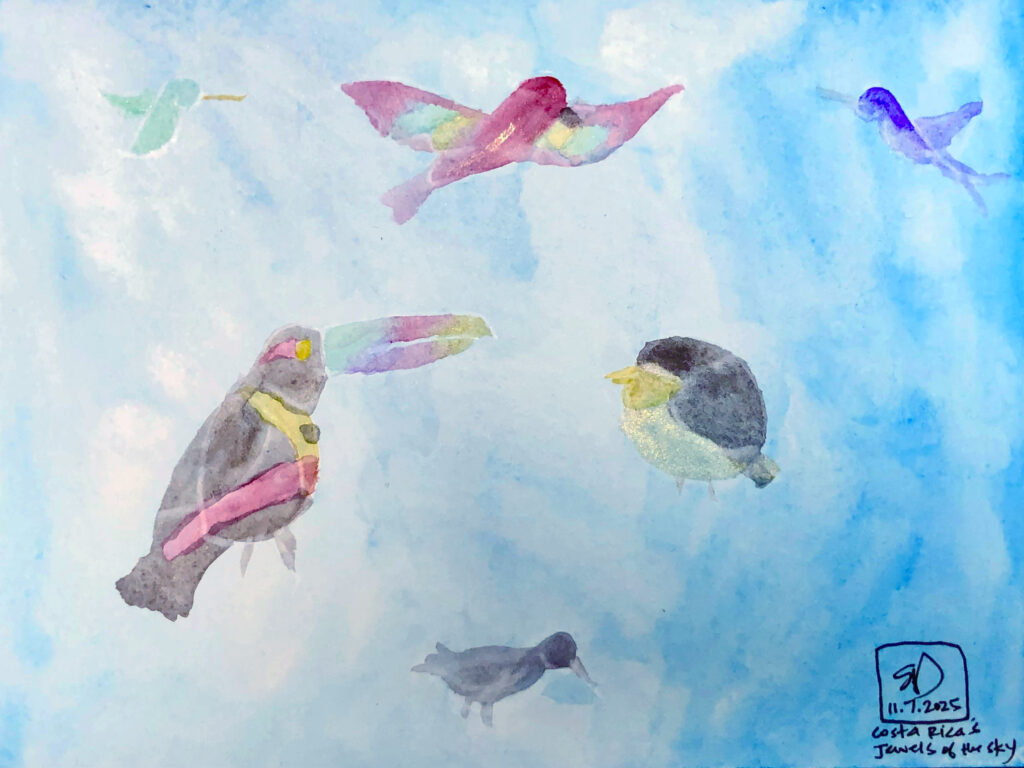
So, during our writing time, I painted a visual map of this post, a quick, free-hand watercolor without any references… just whatever came out of my mind and flowed into my hand as I sat under the majestic Redwoods of the Santa Cruz mountains.
This Black-cheeked Ant-Tanager is perched on a low branch looking for yummy bugs next to the beautiful hand-built Bosque del Rio Tigre Lodge in Costa Rica. This was one of the very first birds we saw when we walked across the river to the lodge. Some birders travel the world to see this rare endemic bird. Amazingly, we saw a pair of these birds every day. They love the sweet bananas our hosts Abraham Gallo and Liz Jones put out for them. This ant-tanager often had “bad hair days” with several feathers sticking out of their head and wing. Thanks to activism, reforestation efforts, and the tanagers’ ability to adapt, their status changed in 2021 from Endangered to Near Threatened.
Fiery-billed araçaris are a medium-sized species of toucan in the genus Pteroglossus that live only in the humid lowland forests of western Costa Rica and western Panama. The name “araçari” originates from the Tupi people, who are indigenous to the Amazon rainforest.
As I walked along Playa Uvita in Parque Nacional Marino Ballena on the southwestern coast of Costa Rica, a chunk of half-eaten guayaba hit my head. I looked up and saw this Scarlet Macaw looking coyly at me from their perch high up in a palm tree. They were in a family group hopping and flying around the trees eating guayaba and beach almonds. I think this one was a young bird because they were doing funny antics like hanging upside down and squawking, and of course, dropping fruit bits on my head. The Scarlet Macaws won my heart, speaking to me every day with their loud squawks, fruit dropping and gorgeous overhead flight in a rainbow of family groups.
Soon after our family arrived in the high mountain town of San Gerardo de Dota, we took a walk along the main road. My kid spotted a teeny whizzing creature in a small bush with tiny pink flowers. OMG, a Volcano Hummingbird!!! I squealed in delight. This is one of the smallest birds in the world and only lives in the Costa Rica and Panama Highlands Endemic Bird Area. Their Costa Rican name is appropriately Colibrí Chispita Volcanera, “Little Spark!” Their diminutive size, high energy, superfast flight, feeding on 2,700 flowers a day, and gorgeous green, rufous and purple iridescent feathers certainly sparked inspiration in my soul.
Seeing this tiny, gorgeously iridescent purple Snowcap hummingbird got me out birding every day despite the dreary rainy weather we had while at Rancho Naturalista on the Caribbean slope of the Talamanca mountains. This little guy fiercely defended the left side of a verbena bush because his life literally depended on its nectar. He even buzzed and chased off a nearby supercute baby snowcap who likely was his child. In the rain, his bright white cap often looked like a crazy elder punk’s mohawk.
This baby Gartered Trogon flew right up to a branch next to me during a break in a thunderstorm at La Selva Biological Station and Reserve in the Caribbean lowland rain forest near Sarapiquí, Costa Rica. She was with her mama, who appeared to be showing her how to find and eat the berries in the trees surrounding us. Mama would hop around and pick berries with her beak quickly and efficiently, and Baby watched her intently. Baby trogon would stumble along the branches in her cute, clumsy way, and pluck a berry, holding it up in her beak as if to proudly show us what she’d done, and then slowly gobble it down.
On our last day in the tropical lowland lagoons of Caño Negro National Wildlife Refuge bordering Nicaragua, we saw this juvenile Black-collard Hawk while we walked along the village’s main dirt road. The hawk was perched on a broken tree trunk looking intensely down into the muddy water. We stopped and watched. Suddenly, the hawk took off across the water and picked up what looked like a large frog pierced by their huge and sharp talons.
“¡Mira, mira!” our bird guide Jorge exclaimed excitedly. He was peering into a large heliconia plant and set up the scope for us. Through the scope, we saw this Violet-Crowned Woodnymph looking back at us, all puffed up from bathing in the rain. Despite the gray darkness, this little guy sparkled with glittering green, bronzy, blue and purple iridescence. It was a magical moment, in the tropical rainforest of Mistico Park at the base of Volcán Arenal, to be in the company of these nymphs, truly tiny jewels of the rainforest.
I first encountered the gorgeous Turquoise-browed Motmot in story and myth from the shopkeeper of a tiny hidden vegan food stand. On my first day in the beach town of Nosara on the Nicoya Peninsula of Costa Rica, I wandered around the dusty dirt roads in my red-eye-flight-haze, sweating buckets in the tropical heat, dehydrated and looking for food. Like a mirage rising out of the desert, La Tiendita de Plan Veg materialized, and the universe presented to me a much-needed passionfruit popsicle.
The friendly shopkeeper asked me why I came to Nosara, and I told him about my birder kid and how we came to be in nature and see birds. He lit up and excitedly told me about his favorite bird, which perches on the tree next to his stand in the early mornings. He went on and on about how splendid the colors are, how it has this magnificent long tail that swishes back and forth, how it’s a Forest God to him. He wasn’t sure what the name was, so we looked it up on his phone together, and it was indeed the Turquoise-browed Motmot.
The next day, as I walked out of the parking lot at Playa Guiones, I saw a bright blue-green flash out of the corner of my eye. Lo and behold, a Motmot flew up to a telephone wire and swished its amazingly long beautiful tail as it looked down at me. A couple days later, my bird guide Victor at the Nosara Biological Reserve spotted the Motmot pictured here on a branch above us, so I had an up-close-and-personal view of the Plan Veg Forest God.
As soon as I came out of the Juan Santamaría Airport (SJO) in Costa Rica, I was greeted by a male Great-tailed Grackle making an insane racket, seemingly yelling at a group of female Grackles surrounding him. Some of the female Grackles were yelling right back at him. For an invasive species from Mexico (they came only 20 years ago), it is striking and beautiful and sounds prettier than a crow.
I first heard the Great Kiskadee and didn’t know what all the ruckus was until I saw this aggressive and cunning flycatcher, completely unafraid of humans or our ridiculous habits and habitats. This curious Rose-throated Becard was boisterously hunting for insects, flying back and forth from a hanging vine in the jungle path between my Airbnb and the bodega. I noticed her thrashing around in the foliage as I approached. When I stopped to watch her, she stopped to watch me!
1 thought on “Drawing 100 birds: Costa Rica series”
Ly
Love this post. Your bird drawings have so much aliveness to them. I’m amazed at your ability to capture movement and personality of each bird. Keep these coming. So happy to be on this birding journey with you my dear friend!
Please let us know your cookie preferences. Cookies are used on this site to support comments and analyze usage.
Please let us know your cookie perferences.
Cookies are used on this website to allow comments and analyze usage anonymously ("statistics"). The only page on this website that includes non-anonymous tracking is the "contact" page. You are welcome to choose how you want us to use cookies for your visit.
Essential cookies enable basic functions and are necessary for the proper function of the website.
Name
Description
Duration
Cookie Preferences
This cookie is used to store the user's cookie consent preferences.
30 days
These cookies are needed for adding comments on this website.
Name
Description
Duration
comment_author_email
Used to track the user across multiple sessions.
Session
comment_author_url
Used to track the user across multiple sessions.
Session
comment_author
Used to track the user across multiple sessions.
Session
Google reCAPTCHA helps protect websites from spam and abuse by verifying user interactions through challenges.
Name
Description
Duration
_GRECAPTCHA
Google reCAPTCHA sets a necessary cookie (_GRECAPTCHA) when executed for the purpose of providing its risk analysis.
179 days
Statistics cookies collect information anonymously. This information helps us understand how visitors use our website.
Google Analytics is a powerful tool that tracks and analyzes website traffic for informed marketing decisions.
Contains information related to marketing campaigns of the user. These are shared with Google AdWords / Google Ads when the Google Ads and Google Analytics accounts are linked together.
90 days
__utma
ID used to identify users and sessions
2 years after last activity
__utmt
Used to monitor number of Google Analytics server requests
10 minutes
__utmb
Used to distinguish new sessions and visits. This cookie is set when the GA.js javascript library is loaded and there is no existing __utmb cookie. The cookie is updated every time data is sent to the Google Analytics server.
30 minutes after last activity
__utmc
Used only with old Urchin versions of Google Analytics and not with GA.js. Was used to distinguish between new sessions and visits at the end of a session.
End of session (browser)
__utmz
Contains information about the traffic source or campaign that directed user to the website. The cookie is set when the GA.js javascript is loaded and updated when data is sent to the Google Anaytics server
6 months after last activity
__utmv
Contains custom information set by the web developer via the _setCustomVar method in Google Analytics. This cookie is updated every time new data is sent to the Google Analytics server.
2 years after last activity
__utmx
Used to determine whether a user is included in an A / B or Multivariate test.
18 months
_ga
ID used to identify users
2 years
_gali
Used by Google Analytics to determine which links on a page are being clicked
30 seconds
_ga_
ID used to identify users
2 years
_gid
ID used to identify users for 24 hours after last activity
24 hours
_gat
Used to monitor number of Google Analytics server requests when using Google Tag Manager



Love this post. Your bird drawings have so much aliveness to them. I’m amazed at your ability to capture movement and personality of each bird. Keep these coming. So happy to be on this birding journey with you my dear friend!